History of Sanibel Lighthouse Cottage 3
By · CommentsMove over Nancy Drew! There’s a new girl on the beaches of Sanibel solving our own Beach Bling mysteries.
In a few posts a couple of weeks ago, I mentioned there are some chunks of concrete, bricks and debris I’ve never seen before that have been uncovered because of beach erosion by the Sanibel lighthouse. Remember?
The first thing that caught my eye was this piece of concrete with a layer of aqua linoleum or tile adhered to it. Hmmm. Where did it come from? I wanted me a piece of that aqua Beach Bling!
Then I saw pieces of red brick scattered around…
There were random bits and pieces of concrete every where…
So I put on my Pamsy Drew hat and tracked down the very man that buried this rubble 40 years ago… Charles LeBuff.
While working for US Fish and Wildlife Service, Charles LeBuff lived in the beach cottage called Lighthouse Quarters 2 (which is still there today) in 1958 through 1979 when the Sanibel Lighthouse facility was headquarters for National Wildlife Refuge.
Jackpot! He knows the history of each of those pieces of rubble and wrote two books telling the story!
As he stated in his book, Lighthouse Quarters 3 was built in 1942 to house the Coast Guard’s wartime beach patrol. Then became a guest cottage rented to Service employees for vacation retreats.
Unfortunately, the cottage was torn down in 1969 because a Washington office employee complained about an odor of stinky bait which had been left in the unplugged refrigerator. At that time, the regional refuge supervisor thought that shutting the cottage down would be easier than maintaining it so they tore it down. What?? Was he crazy?
Charles said when they tore down the cottage, they burned the wood and used heavy equipment to move all the other remains of the building (concrete, bricks, etc) closer to the water. Charles pointed out that the aqua color on the concrete was the tile floor of the cottage.
The bricks were from the chimney of the cottage…
After demolishing and burying this cottage 40 years ago, he recognized each piece of this “Bling” and told me what it used to be.

Sanibel lighthouse cottage 3 page 41 in Charles LeBuff's book J.N. "Ding" Darling National Wildlife Refuge
Isn’t it so interesting how much you learn from getting out on the beach just to go shelling? I did see lots of good shells getting stuck around those concrete chunks but my curiosity about that “Bling” got the best of me and I didn’t pick up one shell.
Talking with Charles at “the scene of the crime” was fascinating. Of course I thought y’all would enjoy hearing him as well, so I made a short video so you could meet this memorable man.
I was tickled to hear him tell the stories about the “old days of Sanibel Lighthouse” and I also enjoyed browsing through the pages of his two books… “Sanybel Light” published in 1998 and his latest one “J.N.Ding Darling National Wildlife Refuge” published in 2011. You can find the books here on Sanibel at MacIntosh Books where Charles works on Sundays or on his website Sanybel.com. 
I’m so happy to tell you that the wonderful couple that now live in Lighthouse Quarters 2 love shelling too. Here are Judy and Dennis who have been in the cottage for 10 years and are now…. the “keepers of the Lighthouse”…
PS- Speaking of shelling at the lighthouse, Donnie found major treasure over the supermoon weekend. A JUNONIA! That makes #2 for him almost in the same spot as finding his first one six months ago as I showed in Another First Junonia. Congrats again Donnie!
Breaking The Case of Lightning Whelk Eggs
By · CommentsI wasn’t able to enjoy the shelling while the super moon tides were at the lowest this weekend since I was tied up with other “stuff”. But high on the wrack line there are still so many LIGHTNING WHELK EGG CASES on the east end beaches of Sanibel.
Since I’ve been dissecting some of the BEACH BLING I’ve found over the last week (like the SEA WHIPS), I decided to go ahead and open up one of the dried out LIGHTNING WHELK EGG “disks”.
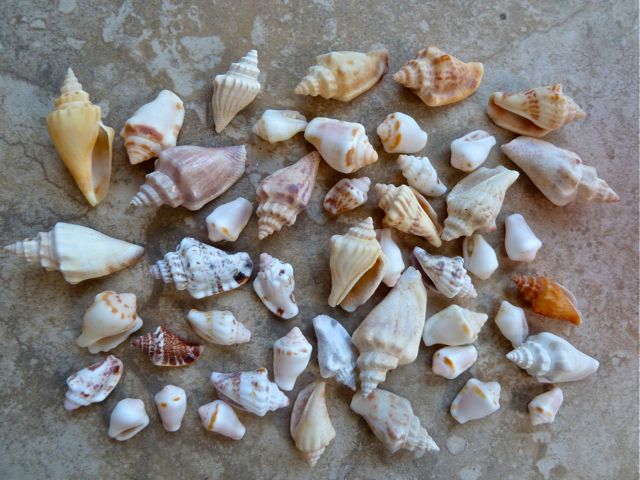
There are teeny tiny little LIGHTNING WHELK shells in some of the disks.
Isn’t that just a wonder? Talk about miniatures!
I didn’t find that many discs with baby WHELKS in them in this case because it looks like most of them “hatched” already. You can see a little round hole on top side of the discs… this is escape hatch! They use this when they are ready to explore their brave new world.
Just to show you how teeny tiny the WHELKS I popped out of the case were, I’ve added one of these little juvies in this Wheel of Whelks surrounding a penny.
PS-Since we didn’t get to shell the super moon tides, I thought I’d show you what Donnie and his girls found…. a GOLDEN OLIVE!
He also sent a photo of all his goodies. Dang! I hate that I missed it.
PSS- I’ve been on a researching binge lately so now I’ve broken another Sanibel mystery case wide open… stay tuned!
Beach Bling Clinging To Wing Oyster
By · CommentsI found more shells clinging to SEA WHIPS! This time I found quite a few ATLANTIC WING OYSTERS hitch hiking on those beautiful SEA WHIPS I talked about on my last post.
Notice how pearlescent the inside is! I didn’t want to break the two valves apart but you can peek in to see the beauty.
I found quite a few of these attached to the SEA WHIPS I found in the BEACH BLING last month.
I know, this WING OYSTER doesn’t look that pretty hanging on to this gorgeous purple WHIP but he would definitely clean up nicely if I chose to untangle him.
I’m just always amazed at what I’ve overlooked before.
I didn’t find all of these on the beach in the last month. I looked through some of my other SEA WHIPS I collected through the years and low and behold… I didn’t even realized I had perfect specimens of ATLANTIC WING OYSTERS wrapped up in my WHIPS.
I can’t believe I can’t find the photo (sorry!) …. but at the 75th Sanibel Shell Fair and Show this year there was a display of an ATLANTIC WING OYSTER still attached to a SEA WHIP. I kind of laughed to myself because at first it looked like a dirty purple SEA FAN with some junk not washed off. Then I put on my cheater glasses to look at the display. Cool! A WING OYSTER treasure! I love it- I learn something new every day.
After looking closely at the larger double shells, you’ll be able to see that both the sides don’t match. The two valves are completely different sizes and even the shape is different too.
You might not think these shells are pretty enough to toss in your shell bag, but at least when you see those SEA WHIPS, you might be able to find a little hidden treasure that most other people would pass right by and never see.
Beach Sea Whip Tips
By · CommentsWhile sifting through the BEACH BLING on the east end of Sanibel this past week, I found a purple SEA WHIPS. I’ve collected a few over the years because of their beauty but now I look very carefully at them because at times, I’ll see little surprise hitch hikers on them. Take a closer look…
Did you see the two shells attached to two different branches? They practically camo themselves on the branches, don’t they? They are called ONE-TOOTH SIMNIAS.
On this SEA WHIP I found last week, there are two ONE-TOOTH SIMNIAS attached to this one as well…
I plucked one of the shells off the branch. Look at how sleek it is.
I never find these washed up on the beach… I wonder why? I’m sure they are there so I’m going to keep my eyes peeled for them. Here is the other view…
Since this is a miniature shell I wanted to show you how big the ONE-TOOTH SIMNIA was in relation to a quarter. Unfortunately, all I see in this picture is George Washington getting comfy with one of those travel roll pillows around his neck. I hope you have better luck focusing on the size of the shell instead of the neck roll. ha!
I learned to look closely at SEA WHIPS because I saw a few displays in the scientific division of the 75th Sanibel Shell Fair and Show this year of interesting things that find homes on SEA WHIPS. Here is a very impressive display of a WEST INDIES CHANK SHELL EGG CASE attached to a SEA WHIP with the baby CHANK SHELLS coming out.
Awesome, right? Expert sheller Marilee describes her exhibit as…
“Egg case of Turbinella angulata On sea plume (Pseudopterogorgia) Found on beach after storm near Jack’s Bay- Eleuthera Bahamas”
This was an “Aha moment” for me since she left the egg case attached to the SEA PLUME. Now I always look at what’s attached to the SEA WHIPS or SEA PLUMES mixed in with all the BEACH BLING. Thank you Marilee! It was such a pleasure to meet you at the show.
I have another surprise to show you on my next post about SEA WHIPS. I found another cool shell attached to them! Until then, take a look at another hitchhiker….a BRYOZOAN COLONY hanging out on this purple lovely.
Sea Turtle Nesting Season Begins
By · CommentsSEA TURTLE nesting season begins today! I normally enjoy seeing beautiful beach art but it can be disastrous for a female turtle in nesting season. On our island summer nights from May through October, female loggerhead turtles (and occasionally green turtles, leatherbacks and Kemps Ridley turtles) lay their eggs on the same beach where they were hatched decades earlier. Obstructions like sand castles, beach chairs, coolers or even deep sand pits can distract or injure the mother turtle or her babies after they hatch. Did you know that lights on the beach after dark can disorient adult and baby turtles? Yes, they go towards the light instead of heading to the water so they might end up in the street or parking lot. So we wont be doing any night shelling without red filters on our flashlights until fall. Not a bad price to pay for keeping baby turtles safe, huh?
This is information provided by the City Of Sanibel as a reminder of what you can do to protect SEA TURTLES…
By following these simple guidelines, you can do your part to ensure the survival of these magnificent creatures:
- Turn off or shield lights near the beaches. Artificial beach lighting can inhibit female sea turtles from nesting and disorient hatchlings. Most beachfront lighting issues can be addressed by turning off all unnecessary lights, repositioning or modifying light fixtures, or closing blinds and drapes.
- Remove furniture and other items from the beach and dune area, when not in use, between the hours of 9:00 P.M. and 7:00 A.M. Items left on the beach including beach furniture, toys and trash may provide barriers to nesting or result in entanglement and predation of hatchlings.
- Level all sandcastles and fill any holes dug during play. These are fine during the day but may pose additional hazards at night. Please leave the beach as you found it, so that sea turtles and hatchlings are not hindered on their way to nest or to the water.
- Pick up all trash. Sea turtles mistakenly eat debris, especially plastic, which results in death.
- Honor the leash law. All dogs on the beach must be on a leash and not allowed to disturb nesting turtles or hatchlings.
Collecting Colorful Seashells In The Gulf
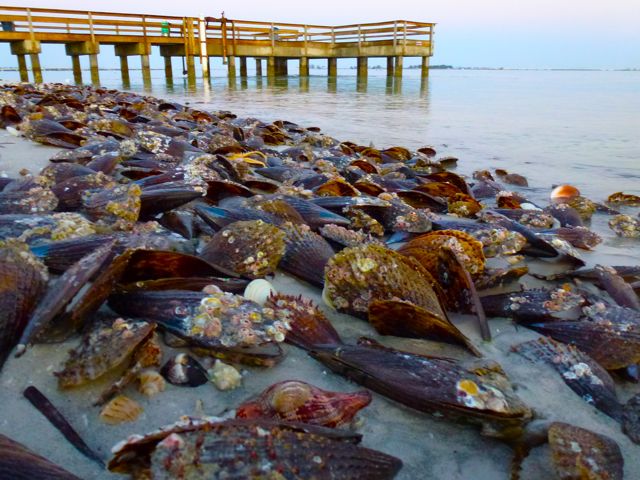
By · CommentsMother Nature has been providing lots of gifts from her sea this week! Not only did she give us all the Beach Bling on the east end, we were finding some excellent shells off West Gulf Drive west of Tarpon Bay Road this weekend.
In the water at the shoreline, Clark found a few ALPHABET CONES, colorful juvie HORSE CONCHS, SHARK’S EYES, dark colorful LETTERED OLIVES and BANDED TULIPS, a double CALICO CLAM and a double ALTERNATE TELLIN.
I was shelling the nice piles on the beach…
I found this sweet little pinkish FLORIDA SPINY JEWELBOX…
And 6 sets of pink and yellow ALTERNATE TELLINS. Here are two of them…
Candy!
Just in case you didn’t catch it in the first photo, take a look at how pretty and dark orange this FLORIDA CONE is. Clark found this just as we were about to leave the beach. It’s my fave shell of the weekend!