
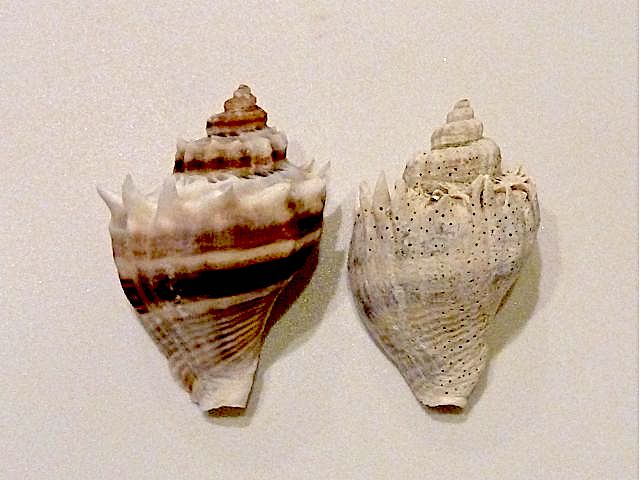
I am so excited to show you how to bring that rich color back to your seashells that have dulled from a white calcium film. I thought I had ruined these KINGS CROWN shells for good after soaking them too long in a bleach solution (1/8 bleach to 7/8 water) to try to clean them up last year. I am so tickled I can save them since I learned a new trick on Monday. I stopped by to see my friend Mary at the Sanibel Community House during a session of the Sanibel Shell Crafters who meet every Monday from 10am to 3pm. She was kind enough to give us tips on using muriatic acid solution to take that white scum off our shells. She did, however, warn us that it doesn’t work on all shells….. don’t use it on OLIVE shells or other shells that already have a shine to them. It will do the opposite…. dull them. So I took her advice, bought some muriatic acid then headed home to mix my brew to make my shells just as luscious in color as when they come fresh out of the water. It works wonders! You won’t believe the changes I’ll show you in the video. Since using Mary’s tips on a few of my own shells, I want to go through every box, bag, jar, bowl and dish of shells I have and dip those crusty old white ones in my brew. I can’t believe I never knew this before but please be aware of the dangers that can be associated with using this or having any type of acid in your house…. it can be DANGEROUS! So read all instructions, wear protective eye glasses, gloves and please dispose of properly.
PS- If you are a serious shell collector, muriatic acid is not the solution you should use on your shells as it is said to damage the shell. If you are a shell crafter, casual beachcomber or someone who just wants to have your beautiful shell displayed in your home that isn’t quite up to snuff …. use your own judgement.
IMPORTANT: Please see all comments by clicking the title of this post.

Beautiful! I can’t wait to try this! Thanks for sharing.
~ Maria
I have shells from my last years trip to Sanibel and decided to finally get to them. After reading all these past posts, decided to try my “tried and true” method of cleaning/removing water “stains” by soaking my shells in vinegar. You should have seen the bubbles coming up, showing that it was working! I had read that vinegar is a disinfectant and one of the very first household cleaners used – I use it all the time in my pots after having boiled something in water, to get the white water marks out and it always works…so why not on shells. I left them in for over an hour and the vinegar had turned murky(I began with a yellow colored “herb vinegar” as white vinegar is not available here in Switzerland) and then I worked on each shell with an old toothbrush. I saved alot of little pink scallop shells and so many turned back to their pink color from a murky whitish color. Naturally this method does not make them shine, but shells don`t natually shine so I am happy with the result!!
Well…I am now eating my own words! The shells have dried from this good cleaning and I`m afraid the colors have faded back to pale!!! I guess I will be trying the oil method to make them shine! Sorry to have posted so soon…however it did give them a good basic cleaning.
Vicky- I just read your comment from a looong time ago. And if you haven’t figured it out already, taking some mineral oil from CVS/Walgreens and polishing the shells with a soft thin towel ( or even rubbing it on the shells your hands ), brings back the color!!
The hands idea is smart, so you don’t overdo it. Thanks! So inquiring minds want to know, can you use olive oil? I feel like this is a question that gets asked on any cleaning thread lol
Personally I would not mess with acid. I did try bleach which seemed to slightly restore the colour of my shells. Baby oil is out, too sticky, but after doing a little experimenting I found that Raw virgin coconut oil that you can buy in small jars from any health store, is great for bringing out the colour on shells.
You only need a little bit on the tip of your finger, rub it into your hands, then handle the shell. I put it on my skin and rub into my hair. Also a teaspoon a day eaten is very good for your health. My shells look great.
WOW Pam! Fantastic video and great information! Thanks so much!
Just tried this and will never do again. When you open the muriatic acid the fumes are horrible. You can actually the fumes coming out of the bottle. Dangerous stuff!
Baby oil, and a toothbrush works for me.
I used baby oil and stored the shells in a glass container for years. Now I would like to take the baby oil off the shells because they smell and I would like to make something out of them. How do I get the baby oil off the shells and continue to have a shiny look.
How awesome is that? WOW! Where does one buy muriatic acid? Can’t wait to try it. Thanks, Pam!
Awesome, I learned something new today! And I can’t wait to give it a try on some of my oldies but goodies! Thanks Mary, Thanks Pam!!
Oops! Thanks Christine- I forgot to add where to get muriatic acid in my post….. hardware stores carry it. Mine came in a gallon plastic jug from Home Depot.
Hunter, that’s what I used to do too…. baby oil or even a bit of olive oil but it can spoil over time and the dust clings to the oil so they don’t dust easily. Yep, I have lots of dust… breezy days with the windows open…. and my furry kitties. One of my pretty kitties is even named “Dustie” but Clark calls her “Dust Ball”.
mineral oil works much better than any other oil and doesn’t get smelly after a while like the others do :)
Do you just brush mineral oil on shells
Traduction (français > anglais)
I use this product long ago. Fan shell Sanibel shared their recipe. I buy at the store muriaticacide the maintenance pool, located next to the campground Periwinkle Park. I just want to stress the importance of the identified solution on the jar with a sticky, you never know who will get close and keep children. As for me, I put in a plastic pot of coffee foldger, muriaticacide identified with a closed canopy and attached.
Pam, I watched your “shell cleaning” video and cringed. Muriatic acid is an ACID. As such, it “cleans” the calcium carbonate shell by actually dissolving/removing the shell surface. The bubbles coming up from the shell in the muriatic acid show that the shell surface is being dissolved. Although this removal of the shell surface may seem to bring out the underlying color, it is actually partially destroying the shell and its surface micro architecture. Bleach, dental picks and mineral oil can usually restore the surface color of the shell without actually hurting the shell.
These comments are not intended to be a criticism, but I do want you and your many readers to know that the use of muriatic acid or any other acid to clean seashells is controversial, at best. If the seashells are to be used only for shell craft, then maybe the use of the “acid wash” is not too bad, but it is also unnecessary, since the shells can be cleaned without hurting their surface. If you ask at the BMSM about the use of acid to clean shells, I’m sure that you will hear even more negative comments. Using acid to clean shells is considered “going over to the dark side” by most serious shell collectors. ;~)
Thanks as always MK for letting us know this fantastic information and what it can do to a shell. I have written an update to the post and given a “disclaimer”. I rewrote it a few times and then got a little tickled because I felt like one of those drug commercials that tells you how great the drug is then right at the end gives a disclaimer of how the drug can cause all sorts of terrible things to happen to you. ;) Just as I’m a seashell common name kind of girl, I love to see my shells in their “prettiest” state (call me shallow- heehee) and I’m a shell crafter at heart. I will never use muriatic acid on a shell like the ROSE MUREX again thanks to you MK, but for me and those drab APPLE MUREXES and totally white KINGS CROWNS, bring on the muriatic acid…… don’t hate me.
thank you!!! I use muriatic to etch pool plaster and would never think of using on my shells.Hope noone tries to acid bath their gem cypraea leucodon…lol..or sinistral Junonia!
I know this is an old post, but I’m hoping maybe someone will see this here and be able to give me some input. I just learned about Sanibel a few days ago, and found your website while googling it, Pam :) Love seeing all the beautiful photos!
Last year I went to the beach with my family – only the second time I’ve been to the beach in my life! I was excited to collect shells… this was out in California, so I didn’t find a ton, but what I did get I took back to my mother-in-law’s house and soaked in bleach. A lot of bleach. For almost a full day. Because I was not terribly well educated on the topic and a little squicky about the possibility of stuff being alive, even though I know there wasn’t anything ;P
So now my mementos look very, very dull. I am wondering what I can do to make them better (if anything). I have not tried any type of oil yet. I was thinking maybe the acid would help me, since I’ve damaged the shells outer layer already anyway :( But I hesitate to use it since I have small kids around. I’d appreciate any advice :)
Good statement. I am a huge collector of shells. I have left mine set for years then get them out to do a craft. I have boiled them in vinegar and the color comes back. Spray with a clear sealer, and the color really comes out. That is not harmful to do outside. I use the burner on our grill to boil outside. 1 part vinegar to 3 parts water. Thanks everyone for all the ways to clean shells.
This has been bothering me all week and I finally came back to put in my two cents only to find that MK already did. I would like to add that if you do choose to use this as a way to bring out the color in shells, you should be wearing protective eyewear, acid-resistant gloves and clothing to cover all exposed skin.
Let’s not forget to mention the health hazards: It can burn your eyes or skin. It can irritate your respiratory tract and it needs to be disposed of at a hazardous waste facility — not down a drain, in the trash or down a storm drain. This stuff is very bad for the environment.
Okay, I’m climbing off my soapbox and back into my shell. Thanks for listening.
I was going to use the Muratic Acid as I have some shells with film and crusties that don’t come off with a scrub. If you don’t recommend the muratic acid, what else can be used?
Debbie; I ‘m afraid I do not know what else to use. I have only used bleach for shells so far. Read the other posts and see what people suggest. I only know that Muriatic acid can be dangerous, & must be handled properly, so be careful.
I’ve used muratic acid several times with no problem. I do it outside, with gloves, tongs, and glasses so nothing gets on me and I don’t inhale the fumes. It does restore the color but doesn’t remove the barnacles. I hate those things!
Sherry
You can buy a can of spray clear gloss acrylic – it beings out the color on a lot of shells and makes them shine – get it at a craft store
You gave the ratio for the muriatic acid solution, but what’s the ratio for the bleach solution?
I use a little stronger solution of 1/4 bleach to 3/4 water for my worm shells…since they are white shells already. For most other shells, I use about 1/8 bleach to 7/8 water. I probably put my kings crowns in my worm shell solution so that’s why I thought I ruined them.
OMG!!! Thank you so much for this tip. I have to try it as many of my shells are dull now. I will post about and link back to you! Thanks much!
I have to agree with you Pam! I now have renewed hope for my King’s crowns….we got several a few years ago out on a sandbar….unknowingly I soaked them in the bleach and they lost their color…I was hear sick….I’m going to try this! Sorry MK….just on a few….don’t hate me too!! ; )
Pam Thanks so much (AGAIN) for keeping us informed!!
….That’s supposed to be HEART sick….(oops)
Very interesting! I would be afraid to dump that acid down my sink, with my old pipes. You got guts, girl, putting that nice big tulip in first! Nowadays, when I use bleach, it’s very diluted (just a splash of bleach) compared to what other people use. The exception is when a shell is crusty with barnacles– then I increase the bleach concentration.
I use plain ol’ mineral oil on my shells, as Ken mentioned, and I use a toothbrush to apply it to the textured shells. I let the oiled shells dry before putting them in a container. Mineral oil is easily found in a drugstore, and cheap. I wouldn’t use any type of cooking oil because they go rancid over time. I have heard that the scent in baby oil can also go bad over time, but I have not tested that.
About that DUST: When I first started shelling, I made the mistake of putting my shells in glass bowls that had no lids. Dust everywhere. So I have a little trick for glass bowls. Wet the rim of the bowl by running a wet finger around it. Then stretch a sheet of clear plastic wrap (like Saran Wrap) over the opening, so that it is taught and smooth, and seal the edges over the rim. Then trim around the edges so there is just a bit of plastic wrap overhang . It’s not the most attractive thing in the world, but it’s fairly inconspicuous and most importantly, it keeps the dust out!
I too put plastic wrap on the top of my glass containers after cleaning my shells. Then I use jute or beach themed ribbon tied around the plastic. It hides tends of plastic and looks so pretty.
Cheri, do whatever you want with your shells. I just want people to know the pros and cons of using the “acid wash.” BTW, a 50% solution of lighter fluid and mineral oil applied with a small paint brush to your King’s crowns will also bring back the color and not hurt the shells. I get my shells looking as nice as the ones that Pam shows, but do not use the “destructive” acid. For a picture of some of our King’s crowns (Crown conchs), click on the highlighted MurexKen name, which will get you to our condo website, then click on Sanibel Shells on the left column, then click on Crown Conchs. Many of these shells looked like Pam’s “before” shells, prior to the bleaching and mineral oil treatment. You might consider trying this less expensive method, prior to using the more expensive, destructive acid.
Pam, thanks for your always gracious response. We can discuss this topic further whenever we next get together. Please do not do anything rash with your shells, until then. MK
I clicked on the MurexKen name and have spent the last hour browsing through the most fascinating information concerning the history of shelling on Sanibel, the Calusa people and so, so much more! Thank you,MurexKen, for giving us this “window” into dozens of shell related topics. I will be clicking on your name over and over again for the pure enjoyment of learning all I can about this wonderful world of shelling!
Thank you,MurexKen! I have spent the last hour lost in the history of shelling and so much more! Fascinating!!!!
I was giving bags of shells that were collected back in the 30s thru the 50s. They were sprayed and have a film that has turned yellow. How can I remove this?thank you. Enjoyed reading the comments.
I encourage everyone to try drastically reducing the amount of bleach used in routine cleaning baths, as well as the soak time. Bleach is powerful, and you really don’t need much for most shells.
I am learning much by reading everyone’s posts here. So – I hate to admit this for fear of serious backlash… but here goes. I soaked my shells in a 50/50 solutions of bleach and water overnight because the smell was so bad. I thought it worked, until the next day, the stink was still very prominently there! So, I did it again. Only this time, I left them like that for like 3 days. Thought it worked again until the stink was STILL there! So, at this point, we were home from our fabulous Sanibel vacation. I was not appreciating the smell that was permeating my bathroom where I had my shells. So, in my desperation, I poured straight bleach on them! Then I added like a cup of water. We’re talking like a 95/5 solution. Okay, okay, I know there are cringes, I accept I probably made a big mistake! Problem… they still stink! So I’m being brave by admitting to all of this so that someone can tell me, WHAT AM I DOING WRONG?!!
Like Bird told me “you got guts, girl!” LOL No I’m not cringing because we try to problem solve and we try different things and learn by the school of hard knocks. ;) Okay back to the problem…. there is still something in there. Kim had a great idea the other day. She told us in post http://www.iloveshelling.com/blog/2011/01/30/beach-treasures-and-willet-birds/ that you should put it in the garden with an upside down flower pot over top of it and let the ants have at it. Problem now is they will probably be scared off from the bleach smell…woops! ;). So try this… just hold the opening of the shell (aperture) under your fast running faucet and shake it around pretty hard then dump the water out. Do this quite a few times until you see something dislodge and come out.
The garden works! I had a mysteriously stinky lace murex. Bleach didn’t work, so I tried boiling it, but that didn’t work either. There was probably some rotten bit of snail meat stuck way up in the shell. So I put it in one of my flower beds and let it sit there all summer. (It was just laying on top of the dirt.) The bugs took care of it. No more stink!
When we bring shells home from the beach, we put them on a fire-ant bed for a couple of weeks. The ants devour any remaining carcass and we can proceed with the cleaning/shining process!
Boil your shells in water with a little vinegar as soon as you get them home and clean them after they cool with a tooth brush, pick, etc. Use pipe cleaners to get into crevices.
After collecting some shells that smelled bad, i soaked them in rubbing alchoal overnite and it seemed to do the trick by removing the stench and not damaging the shells. I tried this on figs and whelks and it worked great.
I boil my shells. It kills any little microbes, etc and there is no chemical to be used. After they dry then I scrub off any barnacles, etc with a toothbrush and small dental pick and rub mineral oil into them to restore the shine. This process eliminates all the chemicals, so it’s better for the environment and they look just as pretty or prettier. Also, I have never had any shells stink after I’m done. I boil them for 5 to 10 minutes depending on how many are in the pan and how barnacly they are.
I SAVE MYSELF ANY TROUBLE BY SMELLING EACH SHELL I COLLECT AS I PICK IT UP
. IF THERE IS ANY PORTION OF THE ANIMAL IN THE SHELL, IT WILL STINK. I LEAVE IT ON THE BEACH TILL THE TIDE WASHES IT OUT OR SOMETHING EATS IT OUT. JOAN
Bury the shell in Dirt for 6 months – the critters in the dirt will clean out the debris. I did that and It worked – I have seen the locals do that too.
Hi Pam, Thanks for the tip. I might try it sometime on some of my “surf tired” shells. How does one safely dispose of used muriatic acid? I have successfully returned color to my shells by using clear acrylic spray (matte finish) . New varieties will not turn yellow after awhile . This does a great job on scallop shells. I’ve finished two shell mirrors and a small valentine since I returned home mid January. I’ll send a photo soon. Sue Bunkin
you mix the acid with baking soda. it neutralizes it
Yes,duder66, this does work. From chemistry classes, acid plus base yeilds, water and salt plus gas. In this case muriatic acid plus sodium bicarbonate, you get Sodium Chloride(salt) plus water plus gas(carbon dioxide). Add lots of baking soda but a little bit at a time because it really fizzes. When you stir and there is no more bubbling, all the muriatic acid is neutralized and it is safe to dispose of. I dilute further with more water just to be sure then dispose of it outside. No harm comes to the yard.
Double WOW!!!! They came out so beautiful. I can’t get over it. Thanks for the tip,off to the hardware store tomorrow :) I have to admit,your website is the site to go to for anything related to shelling.
kelli, my experience with the ‘stink’ was not good either considering i was cautious to not take anything with a ‘resident’. after numerous bleaching attempts, i still had that awful smell everytime i opened the jar to add shells. i finally emptied the jar and found the ‘stinky’ one!! (had to so the smell test but i found her!) and it was a mini. i took a tooth flooser pic and dug up in it and low and behold a tiny, tiny piece of something came out….i still can’t believe that a tiny piece of ‘whatever’ caused such a smell. i now do the same thing to anything that is suspicious after my beach trips!! haven’t had it happen again! it seems that we need to take a bit more care of them when we get them home in addition to taking care of them at the beach… aka ‘their home’. happy shelling!
I soak all of my shells in tap water for at least 7 days, changing the water out every day. if anything was alive it will die in the fresh water and the smell should go away. If it still smells after 7 days, try a few more days in the plain water. If it still smells, put it in the garden or somewhere bugs can get to it and wait a couple weeks.
I tried this with a few of my shells, what a difference! I let one soak too long and it disintegrated, oops! Of course I tried it on ones that didn’t really matter.
So much going on here today, I just gotta put in my two cents worth—(good job on the controversy, Pam)
first- I have some crowns that are so white no amount of oil or scrubbing has helped, rather than relegate them to a bucket in the garage, I’m going to give the acid a try (I might try a very dull, white shark’s eye too).
second- as was asked earlier, does anyone know a safe way to dispose of the acid?
third- I ‘smell out’ my stinky shells and first try boiling them to loosen up the debris but if that doesn’t work I put them in a ziplock out in the garage till spring, not many ants around here right now.
fourth- MurexKen, I will never use acid on ‘good shells’, thanks for the input, please keep it coming, we appreciate you.
Since I just learned all this about the same time you guys did, I really didn’t know how to dispose of it either. I just looked up how to dispose of muriatic acid and it says “Don’t put it down your drain!” Read this whole article! http://www.naturalhandyman.com/iip/infxtra/infmur.html
Well Pam, I said that the use of muriatic acid was controversial. Actually, this entire discussion has been worthwhile. Chapters in books have been written on cleaning/preserving seashells. Perhaps some of you know that my family (O.K., mainly me) calls the noxious scent associated with decaying mollusks “the sweet smell of success”. If you think about it, you never smell that odor unless you have been successful at collecting shells, and that is so sweet! ;~)
As for clicking on the highlighted “MurexKen”, I’m pleased that you like some of the other information on my “Sanibel Shells” page (still a work in progress), but my main point was to show you a picture of some of the crown conchs that did not look very good when I found them, but cleaned up pretty well with just bleach, dental picks, wire brushes and my 50:50 solution of lighter fluid and mineral oil. You do not have to resort to using that horrible acid that hurts/ruins the shells!
MK, why do you use a solution of mineral oil AND lighter fluid? I’ve always used only mineral oil and my shells seem to come out nicely, but if there is some advantage to adding lighter fluid, I’d like to give it a try.
Lisa, I just saw your post. Most seashells are fairly porous and contain microscopic pores or holes in the shell. Mineral oil is fairly viscous and has trouble penetrating these microscopic holes. Adding the lighter fluid makes the mineral oil less viscous and permits it to more easily penetrate a short distance into the shell. Since the lighter fluid also has a much lower vapor point, it helps the mineral oil penetrate the shell and then evaporates so that the shell surface is dry and does not feel sticky with any residual mineral oil. Hope this is helpful.
Thanks, I’m going to give it a try. Too afraid of the acid for safety reasons – for the shells AND me!
Can you tell me how much lighter fluid to mineral oil is recommended. I have a new bottle of both and can’t wait to shine up the shells I collected from my first trip to Sanibel!
Thanks,
Karen, Sorry, I am not the one who recommends lighter fluid, just the OPPOSITE. It is among the most toxic chemicals to breathe-very,very AD. Go back and read the other posts. Try non-toxic things first. I do use bleach for northern shells that I want to be “white” (maybe 1c. to a gallon of water) for soaking a lot of shells.
If you try muriatic acid, inquire at the hardware store what kind of rubber gloves to use, and try to do it outside. I might even wear a mask while using it.
ALWAYS READ THE LABELS (especially WARNING ones) on the container. They are there to protect you, but people have to do their own research also.
Good Luck.
I have really appreciated this post too! Thanks Pam, Bird and Judie! It sounds like I might have one or two in my “treasure box” that just has a yucky piece stuck up inside – and yikes! I put all my shells at risk with that bleach! Lesson learned. Now – to search out the one or two stinkies… I was soooo careful to throw any shell with a resident in it back in the water – so it must just be a little smelly surprise hiding and waiting for me to find it while it taunts me with it’s aroma. :) I guess I could look at it the way MurexKen does, “sweet smell of success”. I’m eager to go read what information is in clicking MurexKen’s name!
I, too, spray the seashells I want to display and have look amazing, or the shells I give to friends, with clear spray paint. It makes them look like they just came out of the water….shiny with beautiful color. I’m afraid I’ll be told that’s not good to do, but they look awesome. To see if it will revive the colors in your shells, run them under water and see what happens. That is the look you’ll get after spraying them!
Awesome video and enjoyed all the comments. Thanks for all the great information.
Thanx so much for another way to ‘beautify’ our shells. I too have LOTS of dust and baby oil is just not an option. As always Pam, you are the top sheller and I love your blog!
Pam, thanks so much for the link that explains how to properly handle and dispose of muriatic acid. I have so many shells that have not responded to the bleach/mineral oil/pick treatment. Since my shells are personal collections and not destined for museums, I am anxious to try the acid. I feel much more equipped to handle the acid now that you have shared this information. This is a “last resort” attempt at salvaging shells that could end up in the flower bed.
Since I am a visual learner, it enjoyed seeing the video, too.
Will the muriatic acid work on shark’s eyes, too?
I’m not sure.. I haven’t tried it on a shark’s eye.
When my husband and I came home from Sanibel this year I had two shells that we had done everything to get rid of the smell. We boiled, we rinsed, boiled again, soaked in bleach water, soaked in more bleach water and still a smell. So finally after the two shells dried completely I put them in a zip lock bag with baking soda and left them for about five days and they are now displayed in my bathroom with no smell….
After leaving Sanibel and heading towards the next destination on our vacation (not home) my supplies were somewhat limited as far as making my shells look ‘pretty.’ We wanted to give our ‘hosts’ a special gift of a glass jar filled with Sanibel sand and seashells. After (secretly) searching their bathroom cabinets for baby oil and coming up empty handed I decided to use the Skin-So-Soft that I had purchased in Sanibel to ward off the no-see-ums. IT WORKED-PERFECTLY!!!! The shells were super shiny and more importantly(I think) they smelt fantastic!!!! For those who don’t know Skin So Soft is an Avon product used to soften skin but for some reason wards off biting inspects.
Hi, was thrilled to find your site and imformation. Although a lifelong craft artist, I just started making valentines after classes with Sandy Moran, on Cape Cod, starting in ’09. Valentines have now taken over my life,( I am not complaining!). March of ’12 I am taking a condo for a week to attend everything and to go shelling on Sanibel for the first time. Your videos, and multi pages of information are just wonderful. Now I have info on where to shell etc. It would be very helpful if your pages were numbered since there is information I want to bring with me and I don’t want tp print your many pages. Since the shells seem to be piled high- What is the best footwear and should I bring a rubber gardener’s kneeling pad? What kind of scoops, tools, are best?–available in stores there? MOST important, what are the laws in Florida and Sanibel about taking shells?Thank you for all the time you spend making this site for us. Barbara
Hi Barbara…I also am a craft artist and shell hunter but I am not as knowledgeable as Pam or many others. I would like to share what I have learned from my many times shelling on the islands. I had the same types of questions before my first visit. A good pair of water shoes are sufficient.I prefer the type that cover my whole foot versus some that are more like sandals. Getting in the water to shell is a “must” and the type of water shoes with open backs and sides just fill with sand to easily. There are stores to buy water shoes and I bought them when I got there. I take a thick beach towel and a chair with me along with a netted bag, a small garden hand rake, a small plastic shovel and a med. sized bucket. You can get all items on the island but I purchased my netted bag beforehand. I love a netted bag for a few reasons but the main reason is that sand will fall out as you fill the bag and if I get home and I’m too tired to soak or wash my “finds” right away I just rinse them while they are still in the bag and hang the bag to drain until I get to clean them properly. Be sure to bring water to the beach – even if you don’t plan on being out for long, you will find that time gets away from you if you start finding what the mermaids push ashore! A chair to take a break is good too….all that stooping and walking can tire you out and if you want to take advantage of a “good findin’ ” day, sitting and resting is a good thing to do. You can not take any shells that have residents and believe me there are many. Even mini shells have residents so take a good look before putting what you find in your bag or bucket. You don’t want to get home and have something smelly with you! DON’T forget a camera…..there are sights to behold that you will want to share and be able to look back on; don’t miss the sunsets…they are spectacular. Shells do pile up especially on the Captiva side of Blind Pass beach and I have had a lot of luck when they pile up under the bridge on the Sanibel side of the pass. But even if there are no piles I have found that there is always something to be found and I have NEVER been disappointed when shelling on the islands. The Lighthouse beach has never disappointed me and has always sent me home with mini shells – look at the wrack line and any “wash up” areas on that beach. If there is any seaweed, etc. that has washed up, move it around and look under it….I have found treasures there also. Have fun! Good luck! You will fall in love with the area just like many before you!
Dear Barbara: I too am into valentines (and shelss shells shells) I just go tmy hands on some 1948-1950 Children’s valentines cards. look me up on facebook, if you want to see them. Karen Ruppert-Kelleher.
Hello!
I have been shelling @ Sanabel/Captive and Cayo Costa for about 15 yrs. This year I worked on collecting hundreds of small shells to put into ornaments for Christmas and on small wreaths, etc. For the first time, I tried getting the smell out of some, and barnacles off larger shells by using rubbing alcohol. When that didn’t work I added white distilled vinegar. Put ALL my smaller shells in this solution and (fortunately) only a few large shells. All my beautiful shells turned white! Then I soaked several days in salt water/dried/white again! Then brushed on clear varnish. Color immediately returned but by next day most of color had dulled again. Found this website today and anxious to try out clear paint spray on some, skin-so-soft on others. Decided not to use the acid. Will let you know how it turned out!
Wow this is awesome I have to try this! This is so great I have a great collection of wonderful sea shells myself, however they never look the same as when their wet! This must do the trick! Thanks for sharing
I am a Living Historian, as well as avid shell collector, thanks for a caveat about the acid, we use it, but we do not collect specimens, just shells to show pre contact uses of shells by Native Peoples.
I have a great way to restore a shells shine that is food safe. I use the acid treatment often, but afterwards I rub with Almond Oil. I have restored several historic instruments, (wood flutes and clarinets), and it is what is recommended by the experts for renewing and restoring a finish. It is a miracle oil!
I have never known fine quality almond oil to go rancid and it works wonderfully to rehydrate dried out shell specimens, (especially after an acid rinse). It is also the best way to make your shells child safe. The finish does not seems to pool on the surface and collect dust if you buff them after soaking in the sun.
I usually wait for a sunny day, wash with bleach or acid, then let dry, rub with almond oil and let set in the sun. You usually find the oil needs to be applied twice as it is a fine grade oil and really soaks in. This works wonders.
For stinky shells, I just set them on a fire ant nest and they are clean within the day, (this being the only suitable saving grace for fire ants).
Just returned from Green Turtle Cay in the Bahamas. We brought home a beautiful King Helmet shell. We wrapped it securely in 2 ziplock bags and it still leaked in our luggage. Smell is atrocious, even coming through customs the dogs stopped and sniffed the bag pretty intensely. Anyway, we look forward to trying the fire ant method for cleaning out the shell. Thank you so much!
Personally, I would have to avoid almond oil.
My daughter has a very serious potentially fatal nut allergy.
I would hate for her to pick up a shell to admire it if I had polished it with almond oil.
Like I said, potentially fatal.
After reading all of the above posts about cleaning and restoring color to shells, I am going to try a 1/8 bleach to 7/8 bleach solution to clean them, and then use almond oil to restore shine to them. We are on our way home from Sanibel today, and I am already planning our next trip back!
I want to add that I appreciate the comment about the almond oil being child safe as I have 4 young daughters and I am concerned about the safety of meterials used. Thank you to all those who have taken the time to add their thoughts, knowledge, and experience!
After reading my posts, I realized I meant to say, “1/8 bleach to 7/8 water solution”. Also, I spelled “materials” wrong. Sorry about that!
I did it and it was exciting to see the changes right before your eyes. Can anyone tell me how to keep the shine on your shells. I was using a non yellowing clear coat spray, but a lady scared me and said they will all turn yellow in three years. She said to use mineral oil, so i quickly went out and bought some and coated some new shells, well it was a long process and i can’t seem to get them to dry enough that when i put them in my table top (which has sand in it) they don’t get stuck with sand. Help anyone!!!!
Hi
Thank you soooo much. I cannot wait to try this! My dream to go to sanibel to get shells. We did and the info we got was to leave in 50 bleach and water overnight. We did and they are white, have tried everything else and has not worked. Although the shells we collected are not as unique as all the others they are special to me and want to display them. Had my husband take us from treasure island to sanibel in the middle of the night to go shelling with low tide. While our son and 83 year old mom slept in the room. Yes, also took our son the next morning and he LOVED it as well.Unfortunately the most beautiful shells were alive. we did get some though and can’t wait to try this or go back and try again someday. Live in southern ca I’m hooked on shelling!!!
It’s me again. Just did the acid on my shells!! Some did not change and the rest well, all i can say is WOW!!! Just beautiful, right before our eyes. I was so excited,almost like how i felt while i was shelling for them. Can really appreciate and display differently now
THANK YOU!!!
ps hubby was even awed by the transformation!!
Wow! I just read more of the above comments! I was wondering what people who have been doing this for eons did, so am thrilled to learn about the almond oil! Should I asume one of my lical natural food stores carry a fine quality brand?
Help, We just collected several olive shells and other shells with live creatures on our vacation this week. I kept them in plastic bottles as we were camping and had no way to deal with cleaning the shells. We are home and these shells stink worse than rotten eggs. They are all very beautiful and I would like to keep them. I began to soak them in a bleach solution but didn’t want to destroy their shine or color so I removed them from the bleach. The smell is so bad, I’m afraid my neighbors will soon complain. Any suggestions.
FYI Gwen, it’s against the law to take live shells from our beaches in Sanibel and Captiva (Lee County). Sorry to be harsh, but I never encourage anyone to purposely kill a live mollusk for their shell- not only for the millions of reasons I could write- but as you have found…they have way of getting back.
We were at St. Pete’s beach; I didn’t realize this forum was for a specific beach. For the record, we had no idea those shells were alive until the next morning when the car smelled funky. They went straight into the baggie among other shells. I had to investigate to figure out why the smell was so strong and contain the smell in bottles. I am still not sure which shells stink on their own and which have absorbed the odor. We live on the other coast and have never landed at home with smelly (live)shells. We found a huge horse conch that we promptly returned to the ocean when we saw it was obviously very much alive. These smaller snail shells weren’t so obvious. After researching, I know that the larger shells are referred to as olives and the smaller shells are various types of snails. I’m guessing something washed these guys ashore in the shell bed. Maybe the rough surf this week. But at any rate, we ended up with a stinky assortment of shells. I saw the post to put them in baking soda or an ant bed. Just wondering if anyone had any luck with snail shells. Thanks!
Whew Gwen! Oh thank you for commenting back. I felt bad for sounding like the shell cop but when you wrote the first comment, it sounded like you purposefully took them alive. Whew!
No, I don’t just write about Lee County shelling so thats why I specifically aded that as a FYI. Good luck on your baking soda or whatever else you try- there are some good ideas from others on this post too.
I’m almost sure it is illegal to take ‘live’ shells from ANY beach in Florida, not just Sanibel and Captiva. Its usually not hard to see a creature living inside. Even the tiny shells, the little guy is usually hanging out and you can see him if you look as soon as you pick up the shell. If you wait too long to look, he’ll get scared and go inside to hide.
I just returned home after a brief trip to Sanibel and Pinellas county. I brought back many shells and was reading this blog in preparation for cleaning my shells. I never take any living shell. Even if it is not clear initially, usually the animal can be seen after some time out of the water, so I always check my shells after I am done shelling. Regarding especially stinky shells, I have made a somewhat gruesome discovery. Many of my shells had barnacles on them, which are easily removed by soaking in a fairly dilute bleach water solution. I think just soaking them in tap water alone would also work. I found a beautiful whelk covered in barnacles, but I think the barnacles are kind of cute so I was going to leave them on the shell. I noticed that the whelk was particularly stinky after the bleach water soak. I also noticed that some of the barnacles appeared to have a second layer of barnacle inside the cavity. I removed one such barnacle with my pick to see the inside and discovered it was a very small animal! It smelled awful and was definitely the source of the smell. Further investigation suggested that tiny oysters and clams live in some of the barnacles as well as under and in between them. I went through all of my shells that had attached barnacles and discovered several animals. I felt awful, but did not know that animals inhabit barnacles, so didn’t think to look. Does anyone know if the law regarding the removal of live shells includes barnacles on the shells? I removed all the barnacles that contained animals, but if you wanted to leave them on the shell, I would go the fire ant route. I have found shells covered in barnacles that have turned out to be very nice shells after the barnacles were removed, so I hate to think I won’t be able to collect them.
I know this is a super old post but just in case you see it I wanted to say that it’s not always very easy to tell if the shell has a creature inside. They can bury themselves deep inside easily. Once I had a bag of shells and went back to sit in the car to look at Google maps before going to my next spot when I actually heard clinking in my bag and noticed it moving! I looked inside to find a couple of my shells were alive. Once it sat still, the snail felt safe to try to come out and move around. Thankfully I was still in the parking lot so I promptly got out went back over to the beach and let the Little guys go back in the water. all that to say that of course anyone should check carefully, but it is possible to accidentally take live ones, especially for new shellers. I also figured out that tea tiny crabs can live inside sponges or at least hide out in them for a while so I don’t take those anymore either because once a baby crab crawled out into the sink and freaked me out as well as feeling Bad that I took him from his home. I tried to bring him back to the beach next day but it was too late because he had been in the freshwater of the bathroom sink🤷♀️ … i’ve also had people try to tell me that they never have shells that smell bad and that there must be something alive if they smelled bad, but as we can see from the mini comments here that’s not always the case either. There could be bits of the animal stuck way back in the shell and it doesn’t mean that it was alive. So even the lady who posted about this could be mistaken in that her shells maybe weren’t alive but still had dead snail in them. I have seen dried out shells on Keewayden with the entire snail dried up inside so that happens too.
Pam, i have a 130mm Junonia with a large rush spot on it. Do you have any ideas of how to get it off? I defenitly dont want to end up ruining my shell.
Seashellsv, I had some rust (I’m assuming you meant “rust”) on some sand dollars and a few other shells that weren’t specimen shells so I just used the rust remover “Wink” ( I think that’s the name) and it worked great. I squirted it right on the rust spot and it came off.
Pam and others, Hi. I’ve got a large collection of mostly cowries and cone shells for jewelry and I want to try the acid on the stubborn to clean ones. You said that it would take the shine off of already shiny shells, well some of the shells look like they’d be shiny under all the white gunk. Will it dull these shells, or just clean them? Thanks a lot.
Selina, I really dont think its a good idea to use the acid on any cowrie or cone… or olive or any other shiny shell either. Did you try any of the other methods like mineral oil and lighter fluid as MurexKen suggested? I would exhaust all other method before the acid. Good luck!
Sometimes what looks like “white gunk” on what was once a shiny shell like a cowrie is actually the eroded surface of the shell itself. If so, then nothing will restore the shine to it.
can you bleach sea shells that are white and still have them come out white or will they turn yellow? please and thank you for the answer.
Most white shells come out whiter when you bleach them (like angel wings!) but I have bleached some sand dollars that have yellowed after bleaching so be careful not to use too much on sand dollars.
I find it relaxing cleaning shells, and for me bleach is a better solution to use because using acid just takes away the natural beauty of the shell. After I clean my shell especially conch I use mineral oil also to polish it. I really love this site. Thank you!
I just wanted to let everybody know, I have tried all of your advices on my shells, and the only one that seems to really make a huge difference is the acid. I had seached the web, and many books on how to clean and restore the colors of my shells. I worked in a lab, and I strongly dislike miriatic acid, but in the end when EVERYTHING FAILS, I went out and bought the acid. It made the biggest and prettiest difference I had ever seen. I live in Tampa, and in this area I don’t get as many different types if shells that you guys in in Sanibel, but the once that I can get I loved it like it is my own. Anyways, make sure you wear a mask when using the acid, the smell reminded me of when I was in the Army and I had to go in the gas chamber. Please used it outside, and make sure when you dispose it, you do it according to your local waste management. They will be happy to tell you where and how to dispose of an acid this strong.
Glad it worked for you and thanks for the extra advice on precautions.
Hi Pam,
I love your blog! I have a quick question though. I was wondering as you said it can damage the shell, what would it do to it? How would that happen. Thanks! Please reply ASAP!:)
Well, it’s month past the last comment, but I’m just now reading this – I can answer the one above by supersheller: If you are using straight muratic acid, and you leave the shell in too long, you will have little holes in it, until ultimately it would totally dissolve away. You want to dip it with tongs or tweasers, count to a slow three, and lift it out and into clear water. And it is true – don’t dip your shiny shells (olives, cowries, etc). A sharks eye you might do a quick in and out and rinse. The acid is GREAT for tulips, apple murex, fighting conchs, whelks, etc, And it does help getting rid of the smell. But the ant pile will finish it for you otherwise. There is a lighter, safer solution now called ACID MAGIC that you get at ACE as well – and it works well with the shells (full strength) without quite so much worry about handling. I’ve used either of these for years, and wouldn’t be without it. It doesn’t do much good to oil a shell that is coated with white stuff. You’ve got to get that off first – then use the oil if you wish.Have fun!
I am a chimer.I have been collecting shell for 30 years and now I make small hanging mobils with shells. I want then to shine their true colors but the minerial oil I got gives them color but makes them dull. Has anyone tried acrylic?Won’t the acid make them brittle? I want them to make the sound but not sure what works please advise. thanks you, I love shells in Pa.
I’m just getting into the whole shelling thing… and LOVE it!
You mentioned not using the solution on shells that already have a natural shine such as olives. What would you use on those to enhance the shine after cleaning?
this was so COOOOL!!!! It made all the hours of pacing the beach worth it. The shells were BEAUTIFUL after I dipped them. I used a baking soda and water dip after the acid dip to help neutralize the acid. Then I put them in the water.
Are there any middle GA shell enthusiasts here? I am new to shelling and would like to meet others in the local area with the same interest.
Oh lord, I believe I have yet ANOTHER hobby, LOL. Thank you SO MUCH for sharing this information. I know it will come in handy as I continue and learn.
Happy shelling yaw’ll.
Lyric
http://www.graciouslygrey.com
I just did an abalone shell in the acid, bath and then added the skin so so soft, then rubbed it off and used a triple coast non yellowing spray varnish! AWESOME! thank you so much
I’ve been told that this doesn’t work, but I know first hand that it does. I soak my shells in water/Clorox mixture then rinse them real well, then I rub them lightly with baby oil and let them dry for however many days it takes the oil to soak in good, then I spray them with clear acrylic spray that comes in a can. You can usually find it at Wal-Mart or Michael’s. I’ve never had any problems with any of my shells fading and even though it’s real time consuming, they all turn out so beautiful.
I just discovered this site, and, coincidentally, also just visited Sanibel Island for the first time. I’ve read all the comments and don’t see an answer to my question:
Has anyone tried tile and grout sealer that is used for bathroom and kitchen installations? We just had a strip of pebbles installed in our bathroom shower, and the tile guys used an enhancing sealer (Miracle 511) that makes a matte finish, but makes the pebbles look as though they’re wet. Great colors. I think you can get glossy finish also. What will it do to sea shells? Better than acrylic spray or clear nail polish? I want to make a pendant for my granddaughter from a tiny abalone shell.I’m considering using glossy finish on the inside of the shell and matte finish on the outside.
I am using MINWAX Indoor/Outdoor Helsman Spar Urethane (spray on) and the shells look gorgeous. I’m using them for centerpieces for my daughter’s wedding so I want them shiny and it is so much easier and quicker than hand painting.
I have hundreds of shells so this is just what I needed. Hope you like it. Let me know if you’d like before and after photos.
Hi, this is years later, but I’d love to see before and after pictures! I’m on vacation in Sanibel, reading through Pam’s blog, and contemplating what I want to do with the shells that I’ve gathered!
Sanibel has been my fav for shelling since my first trip over on the ferry in the early ’60s. I now average at least one trip a year, and the island is the source of my most prized shells.
This year (2nd wk of Nov) we found NOTHING worth taking home! Has something happened that has caused such a shortage of shells on the island? Hopefully I just picked a bad day.
My only prizes this year were a few fossil shells that I found on a recently reshelled parking lot. Those were pretty amazing!
Thanks for the great discussion on cleaning and preserving shells. I will also take a look at MK’s site next time I need a virtual sunny day.
We’ve had a run on east winds for way too long… we’ve finally gotten a dose of west!
I used the muriatic acid on my huge tiger cowrie and several cone shells that were covered with a white briney layer and they now look beautiful. I am not a serious collector,but have a deep appreciation for shells. Thank you so much for this video! Maui shell collector.
Hello, GREAT SITE! I have just read most of these posts and found lots of good information. I am in Rhode Island, with different shells, so different problems. I want to find out how to remove the dark brown coating on the exterior of blue Mussels? And how to remove the rust color on large Sea clams & Quahogs (that must come from the iron content in the ocean water). I have been soaking shells (but not mussels) in a bleach solution, which does clean & whiten a little, (I want them to be white & matte-not shiny). I Inquired at Home Depot @ muriatic acid, and was told EXTREMELY DANGEROUS, to use protective gloves, goggles, etc. I have not tried it yet on anything, clams or mussels. Whink rust remover worked a little bit, but I have not fully tested it. It also needs to be handled carefully tho, wear kitchen gloves if possible. I’d appreciate any info on my questions. Thank you.
I have read some of the older posts and cannot believe that anyone would tout lighter fluid over muriatic acid. Both substances are highly toxic while the Inhalation of butane can cause euphoria, drowsiness, narcosis, asphyxia, cardiac arrhythmia, fluctuations in blood pressure, temporary memory loss and frostbite, which can result in death from asphyxiation and ventricular fibrillation. Moreover butane is in itself an acid derived from butyric acid. Muriatic acid or hydrochloric acid in concentrated form can form acidic mists. Both the mist and the solution have a corrosive effect on human tissue, with the potential to damage respiratory organs, eyes, skin, and intestines irreversibly.
Worried about damage to seashells? I would worry more about the health risks and damage to the environment.
THANK YOU VERY MUCH! I know these facts are true, was not sure @ muriatic acid.
I soak my little shells with diluted CLR (60% CLR/40%water) to remove outer layer of calcium on small/delicate shells.
pretty good subsitute for Muriac acid……
….this solution can also dull naturally shiny shells…
********
The CLR can dull shells? Or are you referring to the muriatic acid?
Since shells are made of calcium, i tried a basic chemistry trick with nothing actually toxic. Vinegar bath,,, it still cleans the calcium deposits off, then took a stiff brush to the softened deposits. I neutralized the vinegar acid bath with a baking soda bath when done, so the vinegar would not cause any long term acid damage. Both can be poured down the sink when done, but can be used on a good number of shells before being replaced
There has been much discussion about muriatic acid and it’s effect on the environment. But here’s a way to neutralize it so you can dispose of it safely.
Muriatic acid is an acid (similar to vinegar) but much stronger. We all know what happens if you add baking soda to vinegar- it fizzes!!! Remember those science projects we all did?
Muriatic acid is hydrochloric acid with some sulfur in it(smells like low tide) so when you add a base(sodium bicarb) to an acid(muriatic acid) you get a salt, water and a gas.The gas you see bubbling is carbon dioxide(the stuff in soda), and you get water and salt.
If you remember from science class, here’s the formula:
Acid + Base = Salt + Water + CO2
If you add enough baking soda so it does not bubble any more you can safely pour it down your sink. Flush with lots of water and you have safely disposed of it. Beware, it is going to bubble like crazy and you’ll need a large container or it will overflow.
Hope your eyes didn’t gloss over with this science lesson :-)
Mary, THANK YOU for the science neutralization lesson! LOL Its always good to get more info on this… especially from a sheller!
Pam, no problem. It’s fun to put my chemistry knowledge to use in a fun way instead of the usual boring stuff. Better living through chemistry, as we say :-)
Hi! Came across the website and post while trying to figure out what to do with some conch shells I got on vacation in the Bahamas. The mollusk had already been taken out and I soaked them in a bleach water mixture last night for a couple hours and then I scrubbed them off with a scrub brush. I let them sit in little buckets to dry off and after work today I noticed that the outsides have a very flaky layer that peels off very easily and a very porous layer that covers the crown area and on the other conch shell the porous area is a salmon pink area. Both are very dull on the outsides. Is there any way to get rid of the white and pink porous later to expose the shell underneath or am I actually looking at the shell. Also, does the flaky layer need to come off or can it be left. I’m very uneducated about all of this obviously. Thank you!! (Wish I could add pictures as it would be easier to understand what I’m talking about…)
lauren, I know what you are talking about… the white and pink layer. If Im right, its called coralline algae and It takes elbow grease to get that off. I use a metal wire brush to get some of it off then pick away at it with a dental tool. The muratic acid will eat that away but just like Ive explained in this video- be very careful. Myabe even dunk it quickly in the area that is most effected and encrusted and see if it comes off (of course followed by dunking it in the water). good luck!
Hello,
I recently brought back 5 hand-sized sea clam shells from Gloucester, Massachusetts. I am not an avid shell collecter, but every now and then I picked up just the big ones. They are all encrusted in calcium. And it is pretty thick. I have tried using a metal dental pick but I don’t know how far to go down without scratching the shell. Will this acid work on my shells? Will it get off all or most of the calcuim? Or are my clam shells too weak and brittle to be dipped in acid?
Thanks.
Wonderful info… Thank you! . Does anyone know the proper name for a Florida west coast seashell commomly called a “mermaids mirror”? Have a little girl in love with Ariel and mermaids!
Thank you, thank you, thank you!
Connie, I am unaware of any seashell from the west coast of Florida or elsewhere that is commonly called a “mermaid’s mirror”. I have heard of a mermaid’s comb, which is the Murex shell from the western pacific, Murex pecten, http://www.thefeaturedcreature.com/shell-showcase-venus-comb-murex/ and a mermaid’s purse, which is the egg case of a skate, http://en.wikipedia.org/wiki/Egg_case_(Chondrichthyes) . If you want to purchase a mermaid’s comb for that little girl, you could look here, http://www.ebay.com/sch/i.html?_kw=seashell+comb I hope this information is helpful to you.
I soak my shells in a denture cleaner bath and it works great. I use the antibacterial denture cleanser with baking soda, which kills odor causing bacteria. It’s a secret us hikers use to clean out our reusable aluminum water bottles. It’s inexpensive and it whitens and brightens! I also follow up with using a Mr. Clean Magic Eraser for those shells that have gunk stuck on them. Works like a charm!
ShellSurfer, fantastic idea!! It sounds so logical! Thanks you so much for sharing your insiders secret for hikers- I can’t wait to try it.
I am trying to bring back color in a large starfish I’ve had for years, what is safe to put on it to bring back the brilliance?
A few tips, The acid will keep working in the shells after you rinse them in water. A shell is made to keep an animal inside the shell, it will hold air and water ( or other liquid ) in the inner part of the shell. When you rinse them make sure to turn them and get the water all the way inside!
THE ONLY WAY I MAY USE ACID on shells in the future is brushing a solution on the outside of the shell.
When acid gets inside it ruins the natural shine.
Any weak spot easily becomes a hole.
Sandpaper, Dremal, Sanding blocks, Dental tools, and eraser sponges work great
Just add elbow grease.
I am an amateur shell collector. My shells – collected in Florida, Bali, coastal France etc – have never had bad smells, and since I don’t collect them to have them as showpieces I have simply placed the shells in bowls and glassware around my bathroom tub for decoration purposes. How can I remove the residues (soap, chalk etc) which inevitably over time collect on these shells? Is a mild bleach soak the best alternative, or are the some other home-spun tricks I can use? I haven’t got a clue what mix of shells I have collected over the years so I’m looking for an all-round solution.
How do you responsibly dispose of the acid after cleaning shells?
I found a sensational starfish today…. She (named her Stella, short for Stellar) is a Royal Starfish (purple and orange). I followed the preservation method found on a couple sites (never done preservation before) and her gorgeous purple has become faded and bleached out looking. Did I do something wrong or is this normal? How can I prevent color loss should I get lucky enough to find another? Thank you so much for any tips, tricks or thoughts you might have.
Shell Queen, you did not do anything wrong. I can understand your frustration with starfish and other sea critters losing the vivid color that they had when they were alive and fresh from the water. With time (and especially with ultraviolet light) virtually all biologic pigments degenerate and fade. Sea life that is preserved in denatured alcohol, keeps its vivid colors much longer, but it must be kept wet in the alcohol. Once removed from the alcohol, the sea life tends to decompose. An alternative is to fix/stabilize the sea critter in formalin/formaldehyde, but that tends to cause the colors to fade, as you have discovered. I know of no way around this problem. As you may know, there are plenty of health/safety problems associated with the use of formalin/formaldehyde. Use these chemicals only in a well ventilated location and only with protective/safety gear. I hope that this information is helpful to you.
Actually, I tried this with my seashell, I made saltwater with salt and water, then put my shells in it, and after a while, they regained color. This works with pretty rocks too.
I love your website and information.
How do you know when to use the “acid” and on what shells vs “bleach”?
Should you try bleach first and then acid if bleach doesn’t work?
It seems somewhat confusing.
Can you use something like vinegar to dissolve the calcium buildup?
I soak them in vinegar for a while (maybe 15 minutes) and then give them a light sand with fine sandpaper – either 400 or 600 grit. Finally give them a very light spray with acrylic gloss. Come up great. Wouldn’t consider this though with any quality shell or definitely not if you’re a collector. Only do this for shells that are too far gone to be ‘collector’ quality!
Hi i recently inherited an old mobile which has these beautiful seashells hanging from it. Since they have become very old they have become quite yellow. I want to try to revive their beauty but i´m afraid to damage them. Do any of you have any experience with how to get rid of the yellow color to make them white again. I have baking soda but i´m not sure of how the best way to do this, should i boil the water before i add the baking soda, and how much should i use and for how long?
Pam, I’m having trouble pulling up the video. I have the acid, am aware of the risks and know how to dispose of it. Would you repeat the solution proportions?
Hi, Pam. I just got home from my first trip to Sanibel and Captiva. Had a great time collecting shells on these beautiful islands. I’ve read most of this blog, but I missed a couple of details. How long should I soak my shells in 1/8 bleach and 7/8 water? Where can I get a dental pick? Thanks for all the great info.
Hi Pam, I just returned from a trip to the Bahamas where I found a couple of conch shells lying around on the beach. One is very large and white with a calcium build up and a hole in the top and was obviously completely empty. The other was small and appeared to be empty. Nonetheless I let it sit out for a few hours to see if anything would crawl out and then rinsed it in lots of water and also soaked it in water for some time. Then I shook it, tapped and did whatever I could to try and determine if it truly was empty. Again I let it sit for some time and saw nothing. So I packed it in my suitcase, flew home, unwrapped it and saw two legs sticking out, only to see them quickly disappear deep into the shell again. I’m guessing it’s a hermit crab. My heart sank when I saw him because now I have no way of putting him back to his home on the beach. I live inland, about three hours from the ocean and it’s very cold here. I don’t know what to do with him if he ever does crawl back out. Any suggestions? I don’t want to kill him.
Oh No! I’d take it to your local pet store that carries hermit crabs- they would know how to handle it. good luck!!
Thanks Pam! I brought the shell to a fish pet store and they said they will try to coax him out my shell and into a new one and then they will take care of him. I feel very relieved for him and also look forward to getting the shell back if he does end up going into a new one.
I’m looking for information on cleaning a very old shell collection, could have been collected in the ’40’s, some are labeled as to where they were found, worldwide. But they are very dusty. Some appear to be coral…I’m scared of damaging them.
Has anyone tried using CLR to clean shells, I was just wonders how CLR vs Muriatic Acid did?
This is not in reference to anything in particular, but I have been getting alerts about this topic for a few years and thought I’d comment on my experience. I, too, have spent time on Murex Ken’s website and thoroughly enjoyed it. At some point I think he recommended tung oil and lighter fluid to restore shells without compromising the shell with acid. Prior to that I used acrylic spray varnish, which did very little, and muriatic acid, which worked but ate away some of the shell and was toxic to use. I have to say, the combination of tung oil, used to bring out the original color of the shell and lighter fluid, used as a drying agent for the tung oil, is spectacular. Shells that are all white can regain considerable color over time with this method. I use tweezers/forceps to hold the shell and a paintbrush to apply the tung oil/lighter fluid combination. The tung oil is quite sticky, even with the lighter fluid, but gosh it works well and imparts a long lasting shine, and what seems to be a hard protective layer over the shell. Once it dries completely it is not sticky and I store my shells in glass vases without lids without a dust problem. I have been using this method for awhile now and have not noticed any discoloration of the shells. I have about two gallons of acid in my garage I will likely never use again. I just got back from Hilton Head…not much for shells but every shell and shell fragment I collected got treated with tung oil mixed with a bit of lighter fluid with great results! I even found a new tiger shark tooth. Of note, tung oil is derived from the tung tree, found in China. It is commonly used for furniture refinishing. Thanks Murex Ken for this great shell preservation idea! And to Pam for this incredible website! Can’t wait to get back to Sanibel. Was there the end of January after the storms, just for an afternoon. Have a whole vase of paper figs as a result…sigh…
How much tung oil to lighter fluid ratio do you use?
LIzzie from New Zealand taught me to use green pads by Scotch Brite that scrub but do not scratch. I used them to clean Powa/New Zealand shells.
Hi Pam, I found my very first Sea Horse at Nokomis Beach South of Sarasota. I wondered if you could tell me the best method to preseeve him. He ia all intact with his tail.still attached.Thank you very much
Hi Joan, exciting! Honestly, thenfee ive found were completely dried out without any smell so I’ve never had to do anything to preserve them. They’ve stayed together for years and years. So I honesty don’t know what else should be done to them. Good luck!
how much tung oil to lighter fluid do you use?
If I could show you a picture I would, I left my snail shells in the solution of Muratic acid and water went and saw the video what should they dipped it once well within four minutes Michelle’s dissolved half their size it’s very scary stuff
I rub my shells with a light coating of mineral oil and it brings out the natural colors and gives them a soft shine. It’s inexpensive and safe and a nice job.
Any thoughts on loosening the joint of bivalve specimens? My elegant dosinia from sanibel last month is locked in a 90 degree angle!
I am an inexperienced sheller and my most important question i: How to get rid of the smell? Should I just put all shells in the bleach solution? Or should I do something else with it. Cannot find an answer here (guess my question is too basic) but please help me and my family?
THX Gene
I have been collecting shells for years and the best way to clean them, I have found,is denture cleaner. It restores the color. They don’t have a real glossy shine but, I like the natural look. I make jewelry with them and I don’t want to put any kind of oil on them. I used the tablet form of cleaner.
This is one of those posts I keep returning to any time it’s ‘reorganize the collection’ time and things look a little less shiny. (We drive down once a year now, and come back with boxes bleach-phase clean but too exhausted to sort. Time to fix that! There are five years of boxes to go through… eek!)
The husband heard the word ‘acid’ and officially pulled out the ‘nope, we’re not playing mad scientist (any more than we already do in other craft projects… )’ card.
Skimming down, I read the post about vinegar, and it working — then not working. Tacking vinegar onto the grocery list is far easier than ‘pick up some acid, wouldya?’ I sometimes use it for dyeing fabric and yarn, so he’s used to the workspace areas of the house smelling of vinegar for a few days every year already.
I tried it anyway — and noticed that when the shells fully dried, they were much more white than when they started. This was really obvious since the shells in question were some of the bright red and orange oysters. While I only had baby oil on hand, it brought the color back immediately.
Then I tried it on one of the same kind of shells that hadn’t been dipped in vinegar — and it didn’t come up as vibrant as the ones that had. At a guess, the micro-pitting the vinegar is creating is increasing the porosity of the surface enough for the oil to adhere and penetrate better in addition to removing whatever remnants the bleach and basic surface calcification might be leaving behind.
I wouldn’t try this on something that’s got a shiny surface, or extreme rarities, but it did seem to work nicely for what my family calls my ‘colorful wonky bits’.
I’m also curious about some of the stone and slate ‘seal and enhance’ products that are silicone oils with a sealant/stain resisting agent in them for craft uses (again, not for rarities or shinies). We have some on hand we used on some beach pebbles from Cape May NJ that worked nicely, and since that’s meant to stand up to foot traffic or countertop scuffs for a year or more, I’m optimistic this will be a little more enduring for something that isn’t ever going to be taking that kind of punishment.
Definitely a ‘dark side’ option, but after testing the cheap brand we had on hand for the pebbles on some scallop scraps and seeing good results, this might be something to check out. It seems to be working better on some things more than others — our Cape May clams need too many coats of oil for this to work on them, for instance, and common as they are, some of the colors on them when they’re wet are just breathtaking. It seals before they’re properly saturated. It does seem to apply just fine over the traditionally oiled shells thus far, though, so more experimentation continues!
I have thousands of shells that I have collected over the last 20 years of collecting on Sanibel’s beautiful beaches. I finally took the time about two weeks ago to get the muratic acid out and make my shells beautiful. My 17 year old daughter helped me and it wasn’t that bad at all. My calico scallops look like they just came out of the water and most of my shells look like new.
I agree about not using it on shiny ones like olives, but you can test it out on a shell to see what it will do. There is some smell involved, but I did it outside and had a fan blowing since it was so hot here in St. Louis around the 4th.
I filled a tub with an equal amount of water and acid. I put several shells in a small handled plastic strainer (don’t use metal, it eats it away!) and quickly (a couple of seconds) dipped it into the solution then dumped them into another tub with clean water. I rinsed them really well and then laid them out on old towels to dry.
I have never tried any oils or lacquer because that is too labor intensive with as many shells as I’ve collected. I have tried experimenting with clear nail polish on a couple of shells to give them a shine, but they seem a tiny bit sticky, even when dry.
Hi! Can you recommend a good beach for shelling on Maui? Thank you!
So how do we clean/restore shells of collector quality?
I watched this video and a couple of others before trying this method and am happy to report back with two outcomes. 1) the shells came out beautiful, and 2) I lived to tell about it. lol
I wore gloves, safety glasses, tongs, and a mask with a respirator. I used large glass jars for the acid bath and the first rinse. I also did a second rinse in a large plastic bucket. I kept a water hose running on a trickle nearby. I did all of this outdoors.
When I was finished, I let the shells dry in the sun. I dumped small amounts of baking soda into all three of my containers until I no longer saw any fizz or bubbles. The acid bath took more baking soda than the first jar of rinse water and the bucket of water didn’t bubble at all. When they were completely neutralized, I dumped all three into the PVC sewer outlet that’s connected to my house. It’s the same one we use to dump our RV. We ran water from the hose into the open drain as we dumped the mixture and then flushed it with even more water before closing the cap.
The unused acid is stored in the original bottle, in a plastic bag, in the original box, in another plastic bag, in a large plastic storage bin, AWAY FROM my house and garage.
Just be careful with it, use it as directed here, dispose of it properly, and store it outside of your home. If you don’t want to store it, advertise it for FREE on Craigslist and someone with a pool will come take it off your hands. You will be fine. It’s Muriatic Acid, not an atomic bomb.
For those of you who don’t want to use acid (although I’m trying soon) i used to use my Dremel with the high grit disks very lightly just to get that layer of sea scum that bleach just doesn’t get…. Then i would use the polishing wheel on the Dremel with a little coconut oil to shine it back up…. Worked for me ¯\_(ツ)_/¯
Hi ! I thought I’d post my 2 cents here. Just recently returned from a Sanibel trip and was researching on tips for cleaning and preservation of the shells I collected. Upon reading this thread and others. I’ve concluded that a “softer”: cleaning approach is needed. So a diluted 50/50 vinegar water mix with a magic eraser, toothbrush and dental pick will be my approach. Followed up by mineral oil to achieve a luster.
Ive been vacationing to the Sanibel Captiva area most of my life. Although most of that as a child. Recently I’ve been coming back with my children now and creating new memories. I have a pretty extensive shell collection from over the years. Until now my family had always just gone with the boiling method. But what a struck a chord with me was the cleaning process discussed here in this thread.
In Minnesota here where I live we also have a very addicting collecting pastime. Lake Superior Agates. I have been hunting those most of my life to and also have a extensive collection of them as well. The “go to” method for cleaning and preserving those rocks was and is always a diluted muriatic bath and water rinse followed up by the mineral oil lustering. Works great tried and true. just need to re apply the oil every now and again to restore the luster. When I read through the comments here I realized that the more organic nature of shell specimens would not be super compatible with the muriatic treatment for cleaning. I worry that it could degrade them too much. Like MurexKen stated. Perhaps some specimens such as Kings and heavily calcified Whelks could benefit form the heavier acid wash. But first ill try the lower acid of the vinegar solution. Thanks for the very informative video and dicussion, I enjoy all your videos thanks again!
Hi there, I was told by a huge sea shell enthusiast that muriatic acid never stops reacting with the sea shell, even after rinsing it off and that eventually it makes the shell extremely fragile. Do you know anything about this? Thanks in advance.
Thought I would also weigh-in here. My approach is to take a 50/50 bleach & water mix for 12-24 hours as the initial “bath”. Then I rinse the shells in a large bowl of running water for about 5 -10 minutes, all the while I’m moving and sifting the shells in the water with my hands. Big bath mat to put the shells on t least overnight until completely dry. Here’s the best trick I’ve found so far – FOOD GRADE Mineral Oil. It’s thinner than the mineral oil you’ll get to “stay regular” in the pharmacy aisle at Walmart. NO odor, NO stickiness, and NO issues down the road. I was on Sanibel a couple weeks ago and forgot my bottle of food grade mineral oil, so I ran to Walgreens in Ft. Myers and it was twice the viscosity of my food grade oil that I have been using. I had to re-bleach and rinse off the thick stuff. Re-applied with the thinner oil and they look, feel and smell great! I think I’m going to try a vinegar solution on my Apple Murexes to get rid of the calcification on them instead of bleach. It’s a little harsh for those delicate shells, in my opinion.